AI Job Search Checklist: Resume, Cover Letter, Interviews
AI Job Hunt Mastery: A Practical Checklist for Resumes, Cover Letters, and Interview Prep
A modern job search rewards speed, clarity, and consistency. AI can help generate options, spot gaps, and tailor materials faster—but only with a structured workflow and clear guardrails. The goal isn’t to sound “AI-written.” The goal is to move through high-quality cycles quickly while keeping every claim accurate, specific, and authentically yours.
Set the foundation: role targets and proof of fit
Before rewriting anything, narrow the target. A focused search makes AI tools more useful because the inputs are consistent and the outputs are easier to judge.
- Pick 1–2 target roles and 1–2 target industries to reduce scattershot applications.
- Collect 6–10 job descriptions and highlight recurring requirements (tools, outcomes, scope, seniority).
- Write a one-paragraph positioning statement: who you help, how you help, and proof (metrics, projects, certifications).
- Build a “proof bank” of 10–15 achievements: context, action, result, and measurable impact; keep links to work samples when possible.
- Use AI to summarize job-description patterns and propose skills to emphasize, then verify against real experience before adding anything.
AI-assisted job search workflow (human-reviewed at each step)
| Stage | What to do | Where AI helps | Human check |
|---|---|---|---|
| Targeting | Choose roles and gather job posts | Extract common requirements, suggest focus areas | Confirm targets match experience and interests |
| Resume | Align bullets to outcomes and keywords | Rewrite bullets with stronger verbs and metrics | Ensure accuracy, remove fluff, keep voice consistent |
| Cover letter | Write a short, specific narrative | Draft variants for each company and role | Add real examples; avoid generic claims |
| Interview prep | Prepare stories and Q&A practice | Generate questions, run mock interviews | Refine answers for clarity, honesty, and brevity |
| Tracking | Log applications and follow-ups | Create reminders and status summaries | Follow through and tailor next steps |
Resume upgrade checklist: clarity, credibility, and alignment
A resume wins interviews by making it easy to see impact. AI can help tighten language, but the underlying content still has to be real, measurable, and aligned to the role.
- Start with a clean structure: headline, summary (optional), skills, experience, projects, education, certifications.
- Replace responsibilities with outcomes: each bullet should show impact (time saved, revenue, cost reduction, quality, speed, risk reduced).
- Match the language of job descriptions without copying; prioritize the top 5–8 recurring skills.
- Keep formatting ATS-friendly: standard headings, consistent dates, simple fonts, no text in images.
- Use AI to propose bullet rewrites and quantify impact ideas (e.g., “What metrics could represent this work?”), then validate numbers and context.
- Run a final “truth check”: remove anything not defensible in an interview or reference check.
Practical tip: If a bullet feels vague, add a “before/after” or a constraint. Example: “Reduced onboarding time by 25% by rebuilding documentation and adding a checklist for first-week tasks.” Constraints (tight timeline, limited data, cross-team approvals) make the story believable.
Cover letter checklist: short, specific, and evidence-based
When a cover letter is requested, it’s a fast credibility signal—not a second resume. Keep it tight, tailored, and anchored to proof.
- Aim for 150–250 words when a letter is requested; lead with a role-specific hook tied to the company’s needs.
- Use a 3-part structure: (1) why this role/company, (2) proof of relevant results, (3) close with a clear next step.
- Pull 1–2 achievements from the proof bank that directly match the top requirements in the posting.
- Use AI to generate 2–3 variants: formal, straightforward, and energetic; choose one that matches the company tone.
- Avoid generic claims (“hard-working, passionate”) unless backed by a concrete example.
If AI produces a strong draft, personalize it with details only a real candidate would include: the tool stack you used, the scale of work, a tradeoff you navigated, or a measurable outcome you can explain in one sentence.
Interview prep checklist: turn experience into repeatable stories
Interview performance improves fastest when answers become repeatable. Instead of improvising, build a set of stories you can adapt across questions.
Application tracking checklist: consistency wins
Guardrails for using AI: accuracy, privacy, and fairness
For broader guidance, reference the NIST AI Risk Management Framework, the FTC’s AI guidance, and the EEOC’s resources on AI and fairness.
Downloadable checklist for a faster, calmer job search routine
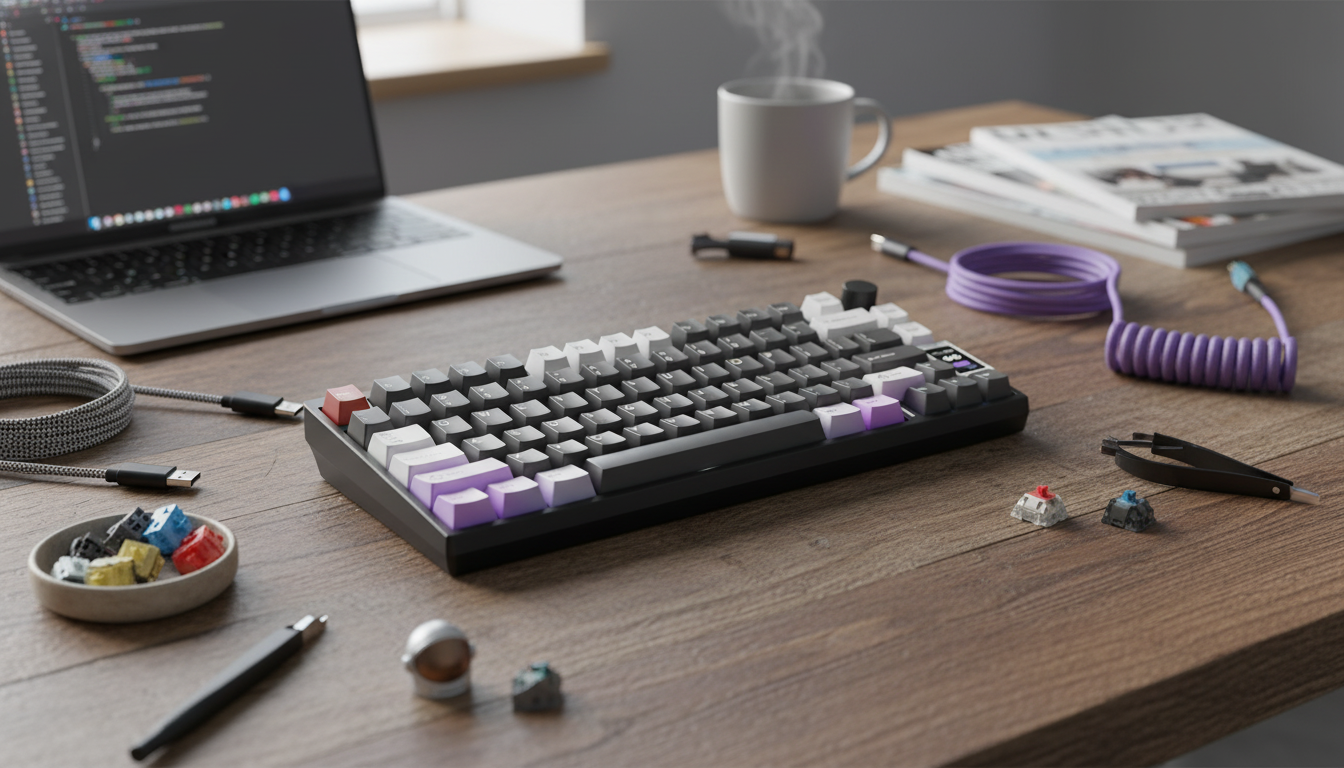
If you want a ready-to-use template you can reuse each week, start with the AI Job Hunt Mastery digital checklist (digital download). For a more efficient application workflow—especially when doing mock interviews, editing documents, and managing tabs—consider upgrading your setup with the Wireless Mechanical Gaming Keyboard with Customizable LCD & RGB Lighting.
FAQ
How can AI help with a job search without sounding generic?
Use AI to generate options and tighten wording, but base every resume bullet and cover-letter paragraph on a specific achievement. Add concrete metrics, tools used, and context that only the candidate would know; keep the final phrasing consistent with natural voice.
Is it okay to use AI for resume and cover letter writing?
Yes, as long as the content is accurate, truthful, and reviewed. AI can speed up drafting and tailoring, but the candidate remains responsible for claims made and should avoid sharing sensitive or confidential information.
What should never be shared with AI tools during a job search?
Avoid sensitive personal identifiers, private employer data, proprietary work, confidential metrics, and anything covered by NDAs. Share only what is necessary and safe; keep details generalized when possible.









Leave a comment